"Nobody wants an agent. People want to get something solved."
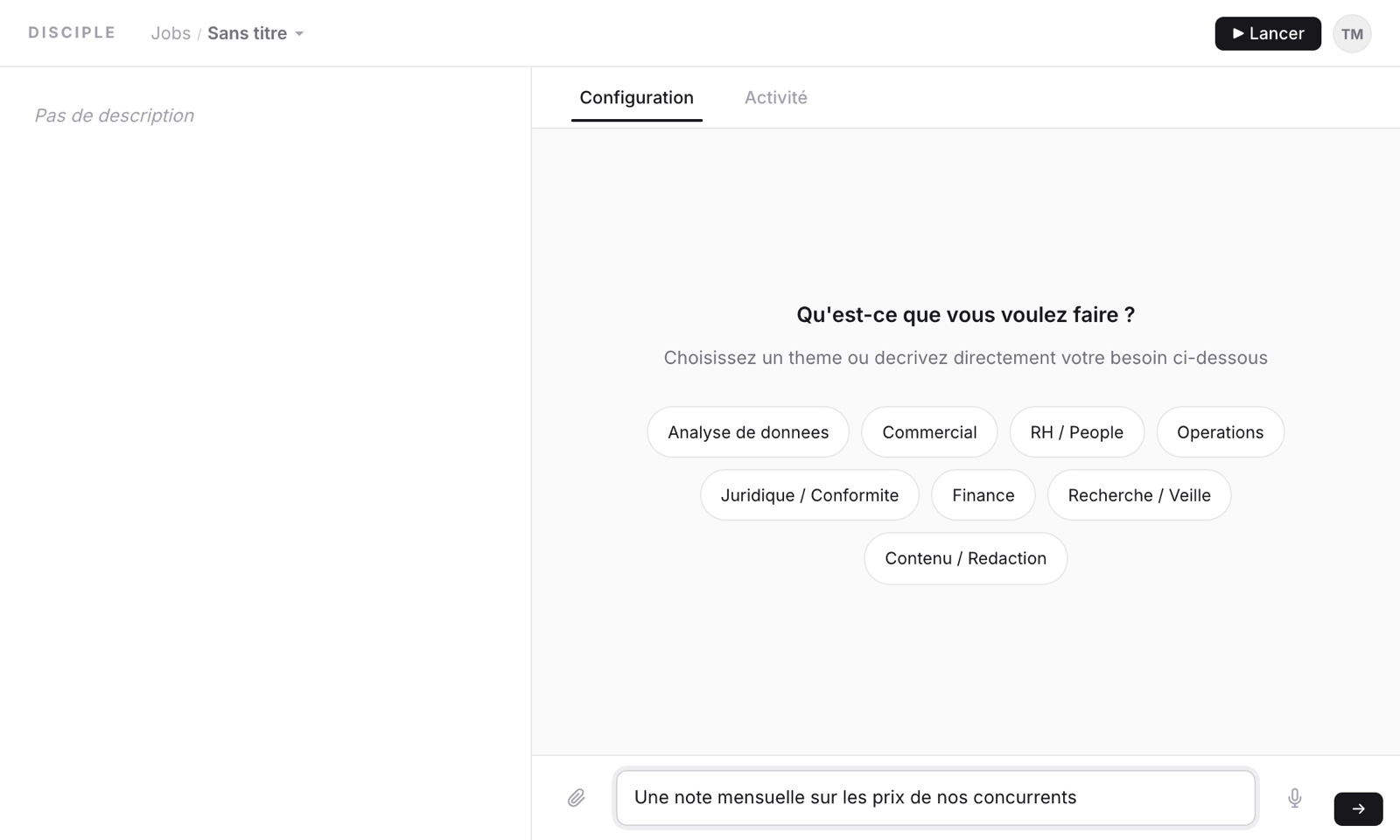
Agent platforms usually start by having you build an agent, with its prompt, its tools and its permissions. Disciple starts from the work itself: you describe it, and the rest organizes itself on three levels.
Every run has a maximum budget, in tokens and in time.
Ten test sessions
The prototype was put through test sessions played by personas: five job profiles and an acceptance tester. From one session to the next, it became more reliable.
- sessions 1 and 2Run through the command line, the architect had no access to native tools and asked questions instead of acting. Tool calls, simulated as JSON in the text, gave it back control: each persona gets its plan in a single exchange.
- session 3On large plans, a sliding window over the history takes the batches from 3/5 and 3/6 successful tasks to 6/6, 7/7 and 6/6.
- session 4Five runs for $1.53 in total.
- session 7First complete run, in about three minutes.
- session 956/56 acceptance checks.
- session 10207/216 across thirteen scenarios, with three-layer evaluations that grade the result rather than the path taken.
In ten days and 84 commits, the prototype learned to run the exchange with the architect, produce a plan, launch the tasks, present the results and keep a memory, and it got continuous integration. Its backlog holds 47 ideas, about thirty of them implemented in a single day, March 24.