You cook a single dish for two people. One of them wants to lose a little weight, the other to stay as they are, and their plates shouldn't hold the same amount. The recipe book, kept in a Google Doc, gave the ingredients for two without saying how much to serve each person.
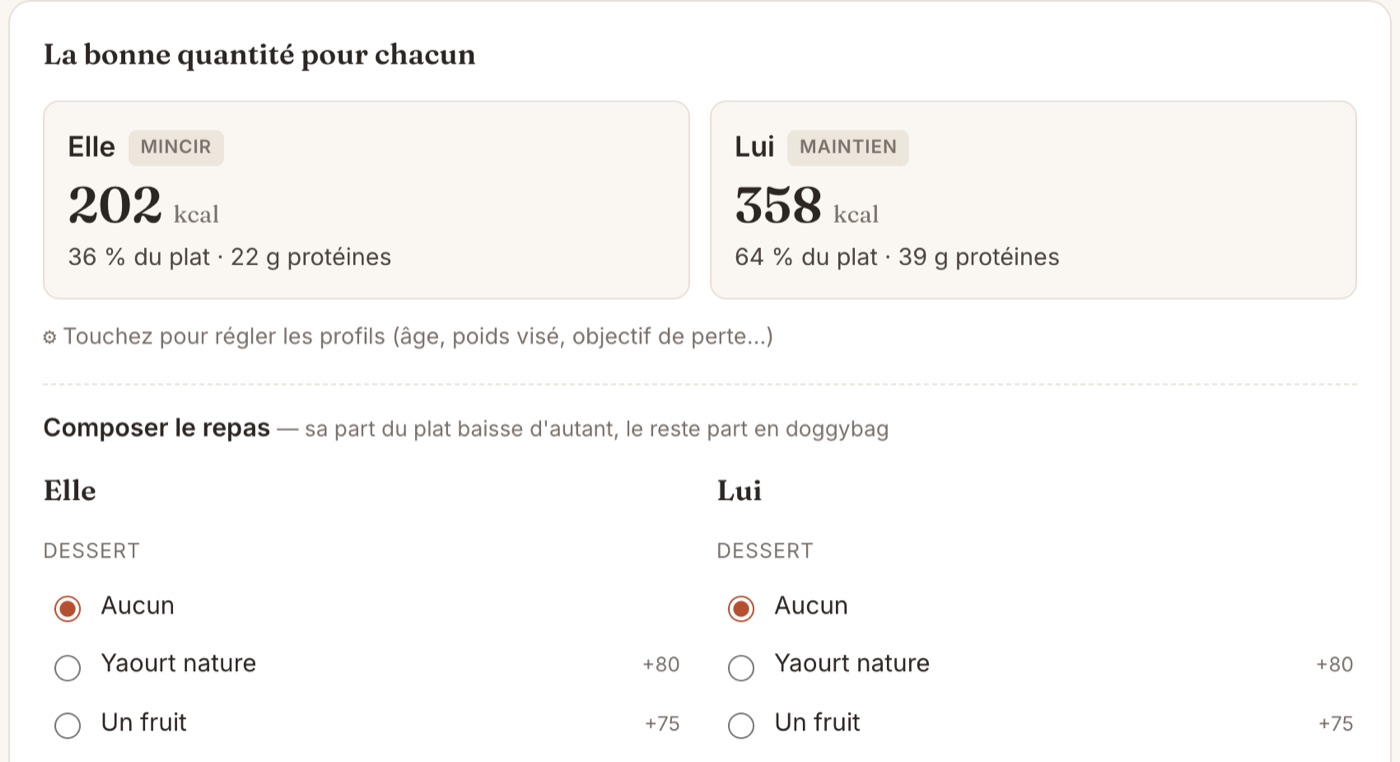
Whole roast sea bream, fennel and lemon · the whole dish, about 560 kcal
in the doggy bag
The app runs this calculation at the bottom of every recipe. It gives each person's share in calories and as a percentage of the dish, then lets you build the meal with a dessert, sides and the day's drinks.
The book's rules
The app has its own principles page, which explains how the book was thought out.
One recipe, two plates. Quantities are for two, and the split happens at serving time: at lunch, the smaller share is around 40% of the dish; at dinner, around a third, rounded out with a yogurt in the evening.
Everything is weighed raw and dry, because pasta more than doubles once cooked and would throw off the calculation.
Losing weight means holding a moderate deficit over time. A kilo of fat is worth about 7,700 kcal.
Oil is measured to the gram and goes where you can taste it, raw, as a finish. A tablespoon is 120 kcal.
Calories go where they give the most pleasure, and flavor comes from what costs almost nothing: salt, lemon, garlic, herbs, sumac, browning pushed further.
June 30
The first commit lands at 2:17 a.m.: a static site, with no framework and no build step, the recipes kept apart in a data file. By 2:39, every recipe says what goes with it.
In the morning, between 9 and 10:16 a.m., the profiles become adjustable, the doggy bag and drinks make it onto the recipe cards, and the recipes move into a file you can edit without touching the code. The profiles leave their own tab for the bottom of each recipe, where they are needed, and the meal builder arrives.
Late in the afternoon, after presets and then a simple choice of sex and kilos to lose per month, the profiles come to be set by objective criteria, and the calculation switches to the Mifflin-St Jeor equation. The cooking know-how and the shopping substitutes, until then in sections of their own, are folded into the ingredients and steps, where you read them while cooking: 351 fewer lines. The twelfth and last commit, at 6:13 p.m., adds a floating bar.
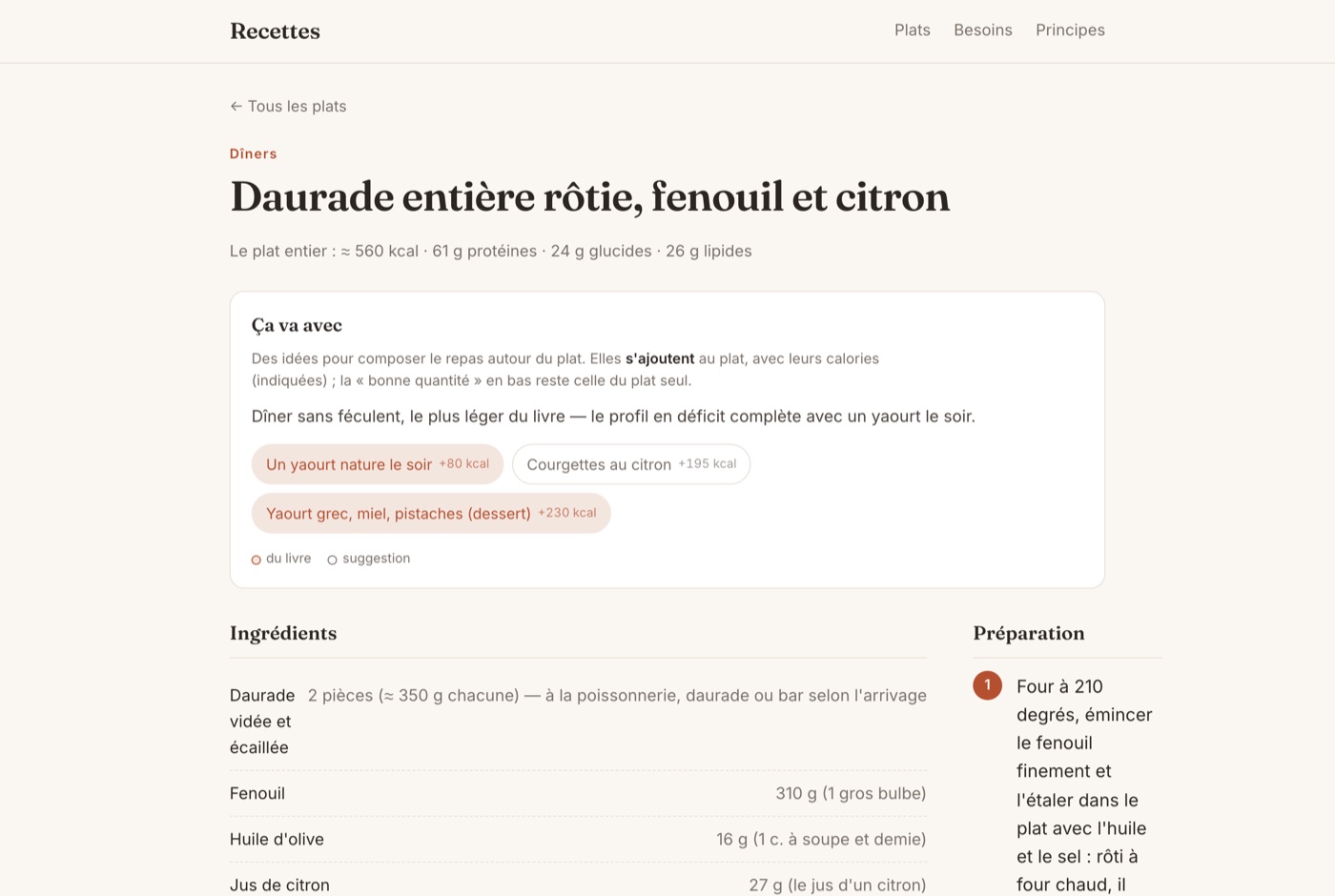
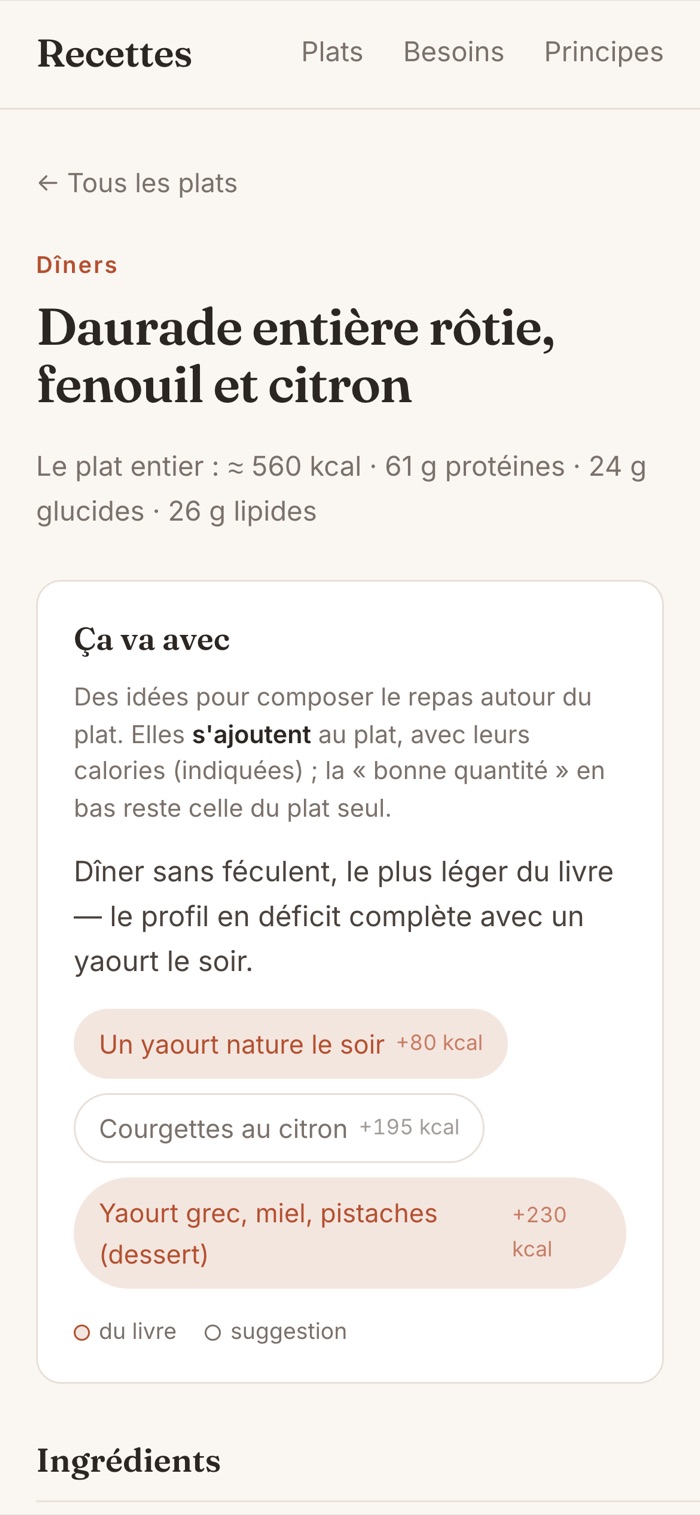
The app holds some forty dishes from southern Europe and the Levant, from lunches to winter stews. Settings stay on the device, and nothing is sent anywhere.