Letting Claude do the legwork of a job search, and keeping the decisions
A register the agent fills in and I read, with nothing sent on my behalf
Since September 17, 2026, in daily use since October 21 · private tool · Next.js, Postgres, MCP · built with Claude Code · full write-up (Markdown)
After a month, tracking my applications meant a 300 KB Google Doc with 1,500-character lines for each opening. Nobody could read it anymore, me included. The legwork of a job search (spotting openings, assessing them, keeping track of every exchange, preparing applications) can go to Claude. I needed a place where it could do that, and where I could see in a few seconds what needed my attention.
The toolClaudeMe
The toolEvery morning, reads 82 public job feeds. A new opening arrives as to sort.
ClaudeQualifies the opening: list, tier S, A or B, way in, fit note. A written assessment, never a computed score.
MeI keep the opening or drop it, in the Selection view.
ClaudePrepares the application from the knowledge base, and asks a question when a fact is missing. The opening moves to ready to send.
MeI read it over, then send it myself. Nothing goes out from the tool.
ClaudeKeeps track: exchanges, the hiring steps announced, tasks, calendar appointments.
The toolFlags the opening if it disappears from its feed.
MeThe Today view tells me what is waiting for me.
The path of an opening, with no company names. Claude goes through an MCP server, some sixty operations, and I go through the web interface; both rest on the same services, and every write is signed by its author.
The tool's spec set two rules. A human must be able to do everything an agent does, and the other way around. And the tool prepares, I send: it computes no score, has no AI built in and never sends a message.
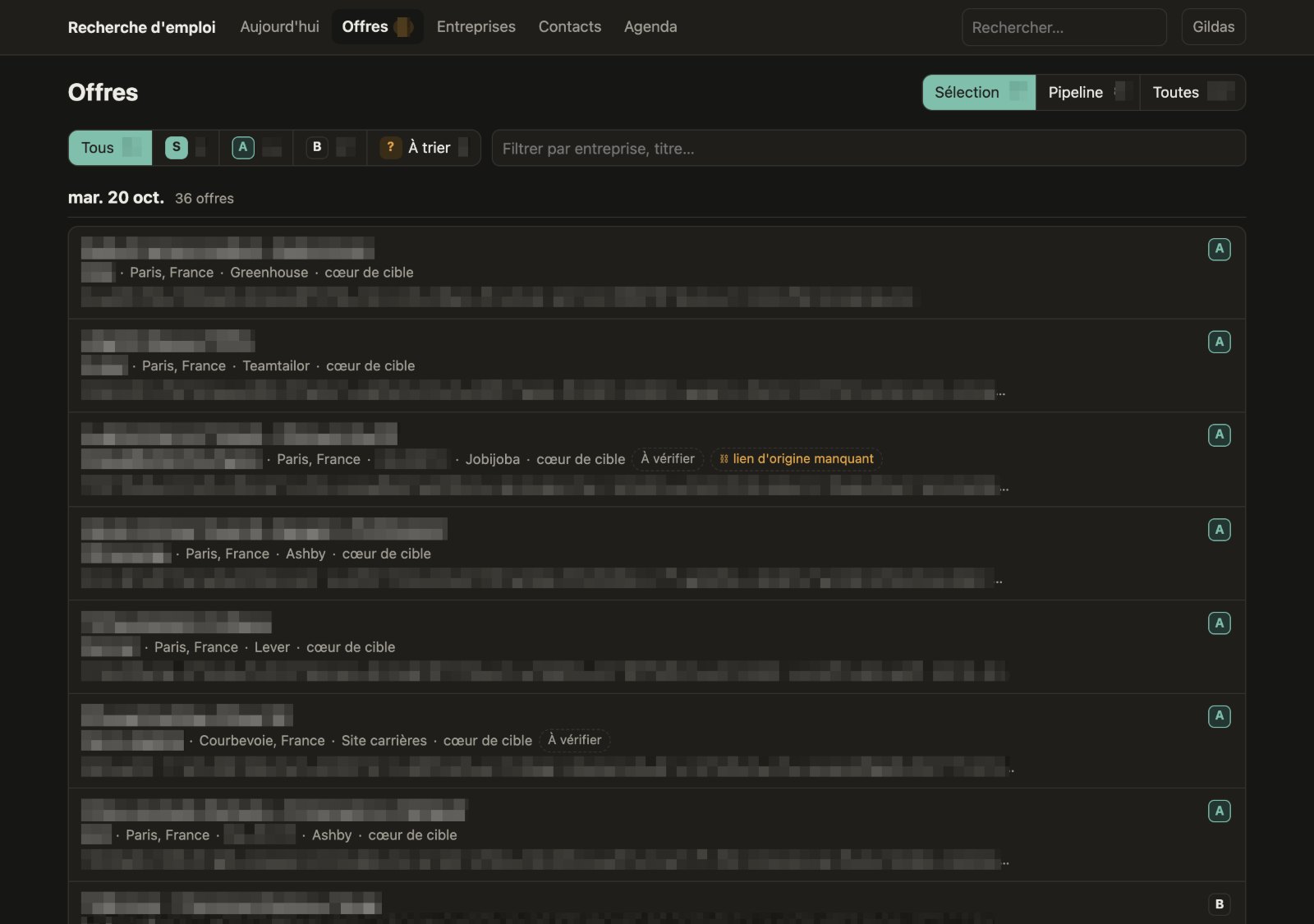
The Selection view, in French, where I keep or drop what Claude has qualified: list, source feed, tier. The tool runs locally here on its starting data; companies, titles, assessments and counters are pixelated.
So that Claude makes nothing up
Before the tool came a memory. Since September 17, a repository of text files has held my profile, my experience, notes on the companies I have worked for, recommendations and a writing method. When I ask for a resume, a message or interview prep, Claude looks there first and cites its files. Every fact in it carries one of three statuses.
EstablishedSaid by me or sourced. Usable as is.To confirmA plausible extrapolation, never validated. Usable only if flagged as such.GapMissing information. Claude asks instead of filling it in.
One tool tried, another built, on the same day
11:15 a.m.5:13 p.m.6:42 p.m.11:00 p.m.
JobSync, tried then droppedthe specthe tool, built by Claude Code
On the morning of October 20, I installed JobSync, an open-source application tracker. Claude imported 118 openings into it. I left it six hours later: its built-in AI assessed the openings itself, when I wanted that role to go to Claude, and it tracked neither the exchanges nor the hiring steps employers announced. The spec for my own tool was written by 5:17 p.m. At 6:42 p.m., Claude Code delivered a complete first version, with the API, the MCP server, the feed reader and an import of the whole history. It was merged at 11 p.m.
The daily watch
82
public job feeds, across eight kinds of ATS: Ashby, Greenhouse, Lever, Teamtailor, SmartRecruiters, Workable, Recruitee, Personio
~3,900
positions read on each run
~110
look like a product role
Only new ones come up for sorting: Oct. 21 83then 1011
The first production run, on the evening of October 21, brought up 83 openings, then 1, 0 and 11 over the following days. A run takes 3 to 45 seconds.
Responses sized for an agent
An agent reads everything it gets back. The MCP server's first responses were too heavy for it. They were slimmed down, with measurements to show for it.
The pipeline142 → 43 KBCompanies133 → 25 KBThe day view57 → 13 KB
The day after the first version, the interface was tightened to five entries, "ready to send" went from a flag to a status, one priority level too many went away, and the feed alert now turns red only after a total failure or two failures in a row.