In HR software, access to a piece of data is not a yes or a no. The same operation can be allowed on oneself, on one's team, on a department, on several legal entities or on the whole company. Lucca's model represented all of this, from the simple case to multi-application, temporary or sensitive configurations. Its flexibility spilled over onto the administrator: to configure anything, they had to rebuild the model in their head. The brief was to simplify the roles screen.
Five moments where the model hurt
The Customer Success memo described the irritants moment by moment. I looked for the problem in a customer's lifecycle rather than in the screen.
- When an instance is createdA doctrine is needed, and there was none.
- When an application is addedFitting its permissions into the existing roles was tedious enough that people created one role per user instead. Every application sold added configuration debt: the cost of cross-selling.
- When an employee is replacedAn exception object is needed, and the only one available looked like a normal role.
- When a works council member arrivesSame thing: an exception with no object to carry it.
- At audit time“Why can this person see this data?” cost more to answer than the configuration had cost to set up.
A figure from Customer Success set the target: in roughly nine cases out of ten, a user would have needed a single role. So the nominal path is designed around a single role, with the exceptions alongside.
The model, in two objects
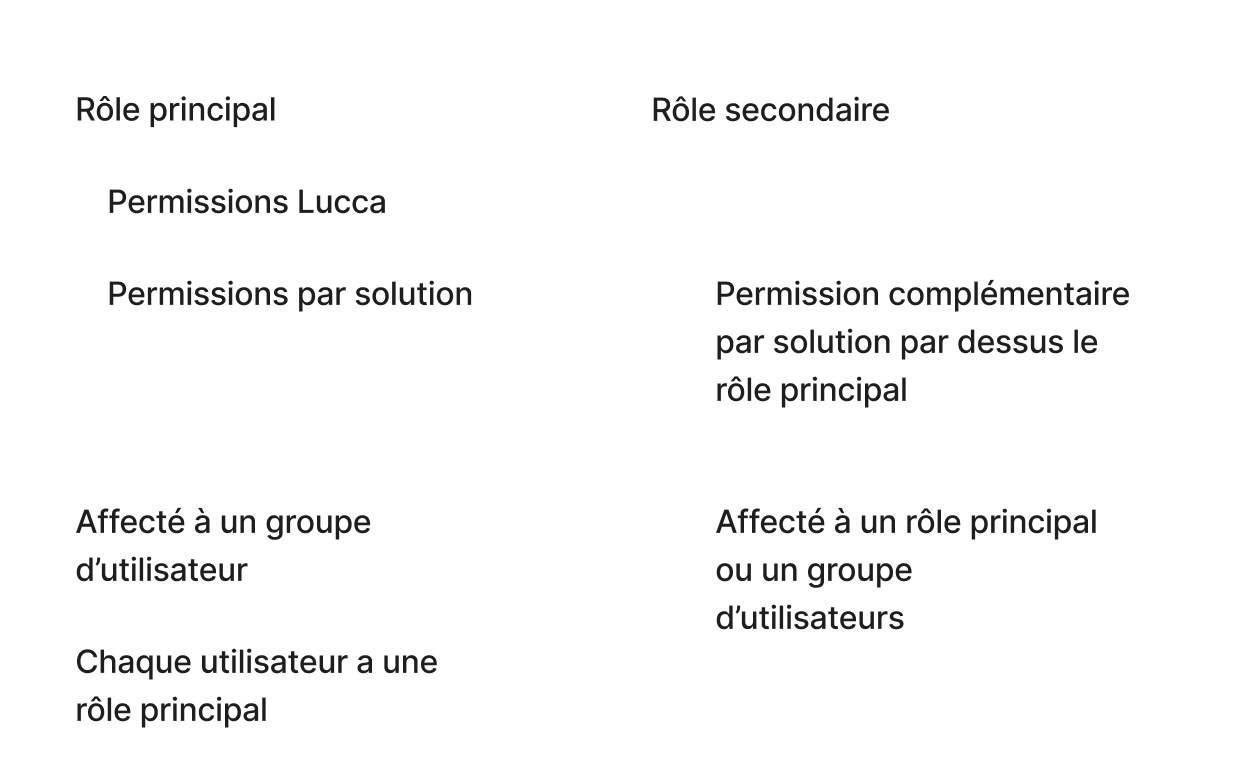
The technical objects stay the same, so migration stays affordable across thousands of instances. What changes is what each one is for, and one new attribute: criticality.
Friction in proportion to risk
A permission's label described an action, not everything it opened access to: a permission could look right for a business need and expose personal data. Rather than hoping the administrator remembers, the interface changes its behaviour with the risk.
The safeguards follow the effect of an action, not the screen it comes in through: a CSV import goes through the same checks as the equivalent action in the interface, otherwise the screen is safe and the system is not. Legacy configurations whose criticality cannot be inferred stay as “unknown”, less comfortable than automatic classification, but the only option that does not make the system lie.
Installing an application without creating debt
And investigation turns around: an entitlements view that starts from a person and traces back to the sources of their rights, logs readable by user, by role and by permission, a diagnostic that flags large exposed populations and near-redundant roles.
What came of it
A vision and a doctrine written in 2025, for use in 2026.
The target usage architecture, the roles guide written by three of us with the task force and shared between Product, Customer Success and customers, the wireframes for the friction flows and the entitlements view, and the migration strategy. The internal roadshow in June presented it to the teams. Two points were still open when my engagement ended: the discoverability of the diagnostic module, and the handling of roles with unknown criticality. The measures are defined, not yet collected: the share of users with a single main role, the temporary access rights still present after a go-live, the time it takes to answer “why this right”.
The deliverables of the redesign belong to Lucca. The only piece from my own files is the note above.